Sales reps spend an average of only 30% of their time actually selling. The rest? It’s eaten up by administrative tasks and chasing down information that should already be at their fingertips.
Fragmented systems undermine pipeline velocity and forecast accuracy. The good news is that there are several sales operations platforms built to solve exactly this problem. Tools like HubSpot Sales Hub consolidate the core workflows of a modern revenue team into a unified experience.
This guide breaks down what sales operations platforms are and how they differ from standalone CRMs. Whether the goal is choosing a unified platform or creating a leaner tech stack, this list helps teams make confident data-backed decisions.
Table of Contents
What is a sales operations platform?
A sales operations platform is software that centralizes and streamlines the workflows for revenue teams. Unlike a point tool that solves one problem, an operations platform unifies multiple sales tasks under one interface. Teams can then automate repetitive tasks, enforce process consistency, and surface reliable analytics across the entire sales motion.
While more advanced platforms layer in AI-driven insights and additional automation, a sales operations platform typically covers:
The defining characteristic of sales operations platforms is integration. Sales Hub and similar software connect data and workflows that would otherwise live in separate systems. Operations leaders then have a single source of truth and a historical data to predict growth.
Sales Operations Tools vs. CRMs
Sales operations tools and CRMs are frequently conflated, and understandably so. Many CRMs have expanded their feature sets to include sales operations capabilities, and many sales operations platforms now include a native CRM. But these tools have two different functions.
A customer relationship management (CRM) platform is a database for managing contacts, accounts, and deal records. CRMs give sales teams a structured place to log interactions. CRMs are relationship-centric. Their primary purpose is to capture the history between reps and prospects.
A sales operations platform, on the other hand, is process-centric. It uses CRM data to automate and optimize sales tasks. In practice, that includes routing leads to the right rep, enforcing data quality standards, triggering follow-up sequences, and surfacing analytics that connect activity to revenue outcomes. Sales operations platforms reduce manual handoffs and spreadsheet-based reporting.
Pro tip: Sales Hub is an operations platform designed to natively integrate with HubSpot’s CRM. Data flows easily between systems, empowering decision-makers and reps.
When to Choose a Sales Operation Platform vs. a CRM
For early-stage teams that need a structured place to manage contacts, a CRM is the best starting point. Teams that already have a CRM but are struggling with manual processes or disconnected reporting should consider a sales operations platform.
Established companies benefit from using both tools with native integration. With a unified platform, CRM data provides historical context for sales operations. Information in the CRM appears in sales tools automatically, so reps and leadership get a unified view of pipeline health. Looking to get started? Try HubSpot CRM and Sales Hub.
Sales Operations Platform Features to Look For
When evaluating options, focus on the capabilities that have the most direct impact on pipeline health and rep efficiency. Helpful features include CRM integration, pipeline management, and revenue analytics.
1. Unified Data and CRM Integration
A unified platform improves forecast reliability by increasing data completeness and activity capture. A strong sales operations platform either natively includes a CRM or integrates deeply with existing CRMs so that data flows bidirectionally and in real time.
This is especially important for small teams just getting their sales operations started, says Guido Tebano, vice president of sales and marketing at Market My Market.
“Early on, your biggest enemy is complexity,” says Tebano. “Your sales process isn’t even nailed down yet. It’s probably evolving every couple of weeks. The last thing you need is a product that takes three months to set up. Simple, fast, with CRM integration. Those are your MVP features.”
Dirty data is the single biggest driver of unreliable forecasts and wasted sales capacity. Data quality management is critical to saving money, while data enrichment adds missing attributes to CRM records. Teams that make data-backed decisions are more likely to beat revenue targets, but only if the data they’re acting on is trustworthy. Look for platforms with built-in data hygiene tools: duplicate detection, field validation, automated enrichment, and data health scoring.
Pro tip: Audit CRM data quality before any platform evaluation. High duplicate rates, missing field values, and stale records will undermine any platform’s capabilities. A data quality baseline gives you a clear benchmark for evaluating platform impact post-launch.
2. Pipeline Management and Deal Visibility
Pipeline visibility is the foundation for both accurate forecasting and effective coaching. The best platforms surface deal health signals like engagement recency, stage duration, and stakeholder management that help operations leaders identify at-risk deals before they slip.
When evaluating a sales operation platform, ask:
- Can the platform automatically log activity across all outreach channels?
- Does it flag deals that have gone dark or been stalled in one stage too long?
- Can you segment pipeline by rep, territory, product line, or deal type with a few clicks?
3. Forecasting and Revenue Analytics
The gap between forecasted and closed revenue is one of the most costly, yet avoidable, challenges in sales operations. A strong platform replaces spreadsheets with structured, data-driven forecasts.
Beyond forecasting, look for analytics that connect leading indicators with lagging outcomes. Reps should be able to tell how pipeline coverage and activity rates translate to revenue attainment. Visibility allows operations leaders to intervene early, not after the quarter has already closed.
4. Workflow Automation and Lead Routing
Manual processes don’t scale. A sales operations platform codifies routing, approvals, and data management as automated rules. With rules, reps can focus on selling and offload admin. Example rules include:
- Routing leads based on territory, company size, or product interest.
- Triggering approval chains when deal terms exceed defined thresholds.
- Assigning onboarding tasks automatically when a new account is created.
“Follow-ups, task creation, and lead routing should not be based on whether or not the rep remembers to do it, because they won’t,” says Tebano. “They’re busy and distracted. If your entire process is relying on the rep doing the right next thing at the right time, your process is broken.”
5. AI Insights That Drive Action
“AI-powered” has become a near-universal vendor claim, but the quality of AI implementation varies dramatically. The difference between AI that creates noise and AI that drives action comes down to the depth of integration.
In effective sales operations platforms, AI surfaces next-best-action recommendations as workflows run, not in a separate analytics dashboard that reps never open. Helpful AI systems:
- Prioritize leads based on fit and intent signals.
- Flag deals at risk of slipping.
- Suggest email follow-up timing.
- And auto-generate call summaries with identified action items.
Pro tip: According to a Gartner survey, sellers who effectively partner with AI tools are 3.7 times more likely to meet quota than those who don’t. Evaluate vendors by asking to see exactly how AI outputs appear in the rep’s daily workflow, not just in an executive reporting view.
Actionable AI is embedded AI. When evaluating AI platforms, ask for a live demonstration of a specific AI feature, not a slide deck. During the demo, ask questions like:
- Where does this output appear in the rep’s workflow?
- What data trains this model? Can I see historical accuracy benchmarks?
- How does a rep take action from this insight without leaving the platform?
Best Sales Operations Platforms
1. HubSpot Sales Hub
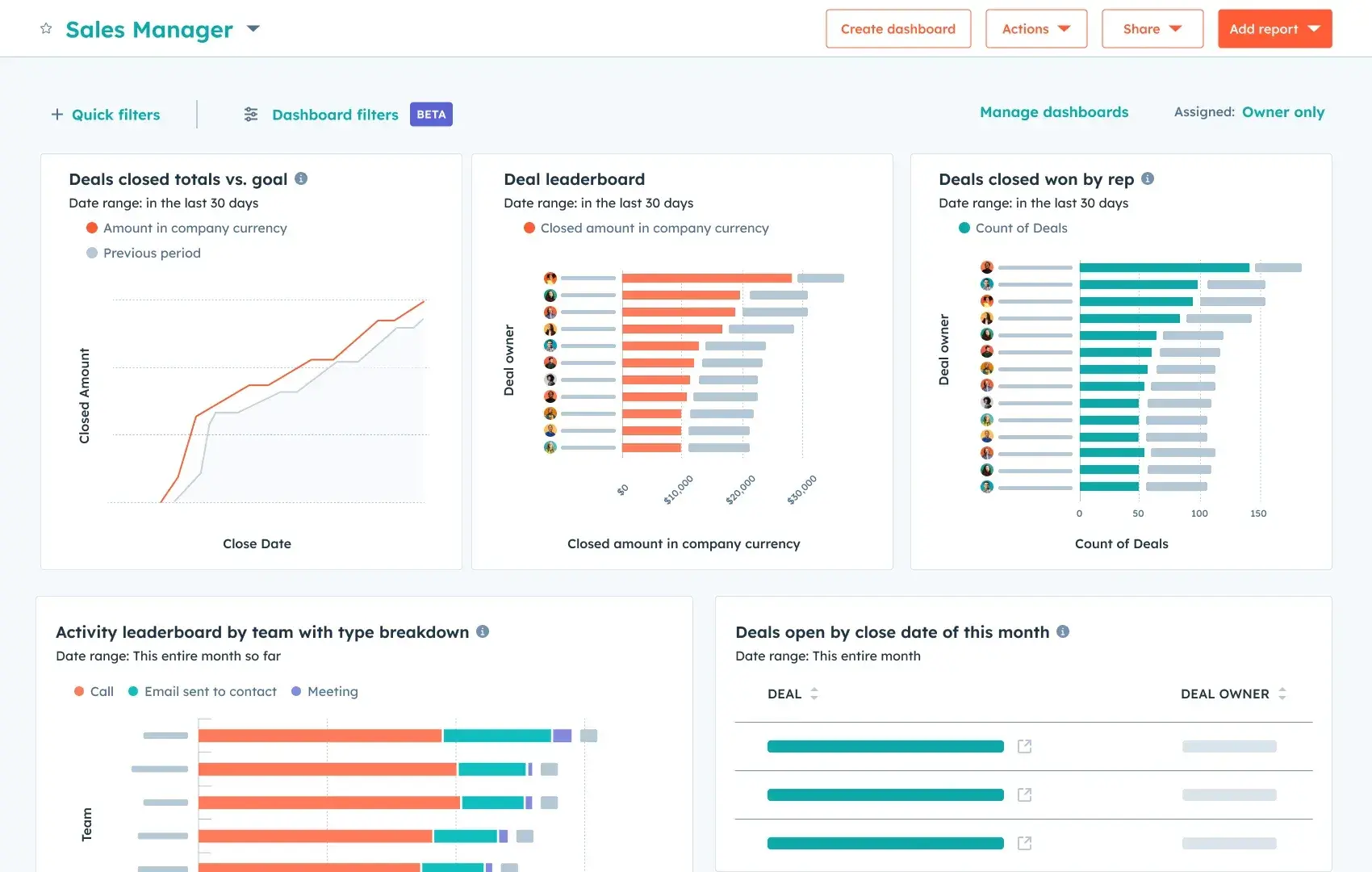
Sales Hub is built on top of HubSpot’s AI-powered CRM and represents one of the most complete, natively unified sales operations solutions available today. In Sales Hub, every prospect interaction, from first touch to closed-won, runs on a single shared data layer. Here are some of the standout features of HubSpot Sales Hub.
Sales Engagement and Automation
Sales Hub enables reps to personalize outreach at scale using enriched CRM data, without leaving the platform. Multi-channel sequences orchestrate email, LinkedIn touchpoints, and calls in a single workflow. Then, real-time email engagement tracking shows exactly when a prospect opened a message or clicked a link.
Sales Hub’s integrated engagement layer removes a persistent CRM problem. When a touchpoint is logged inside the platform, activity capture is automatic. Data quality becomes a byproduct of normal rep behavior.
HubSpot CRM Integration
Unlike CRMs that have bolted AI onto legacy architecture, HubSpot CRM was designed to make AI outputs accessible across every hub and workflow. Contact records, deal timelines, company data, and engagement history are all available in real time, making it possible to surface relevant insights where reps actually work.
For operations leaders, this means the CRM becomes more than a record-keeping system. Instead, it’s used as an active revenue intelligence layer that identifies gaps and suggests next steps based on current pipeline data.
AI Automation
Breeze is HubSpot’s AI system, purpose-built to work across the CRM and all product Hubs. For sales operations specifically, Breeze delivers two high-impact capabilities:
- Breeze Agents are purpose-built and automate defined sales tasks, including a dedicated AI Prospecting Agent that identifies high-fit accounts. For operations leaders frustrated by “AI insights” that require manual action to implement, Breeze is the solution.
- Breeze Assistant helps teams make sense of their CRM data through natural language. Sales managers and operations professionals can ask questions to a chatbot, which pulls custom reports and surfaces pipeline anomalies.
Sales Automation
Automatic activity captures records emails, calls, meetings, and tasks to the CRM timeline. HubSpot’s sales automation covers the full revenue cycle, so routing rules and triggers respond to real-time record changes rather than batched syncs from an external system. Workflows that would require three-system coordination in a fragmented stack can be built in a single interface.
What I like: What makes Sales Hub stand out is the compounding effect of having CRM data and sales tasks in one place. All rep activity feeds the same data model that powers forecasting, routing, and Breeze AI.
There’s no sync delay, no field mapping, and no reconciliation. For operations leaders, that means the work of making your tech stack “talk to each other” is simply eliminated.
2. Agentforce Sales by Salesforce
Source
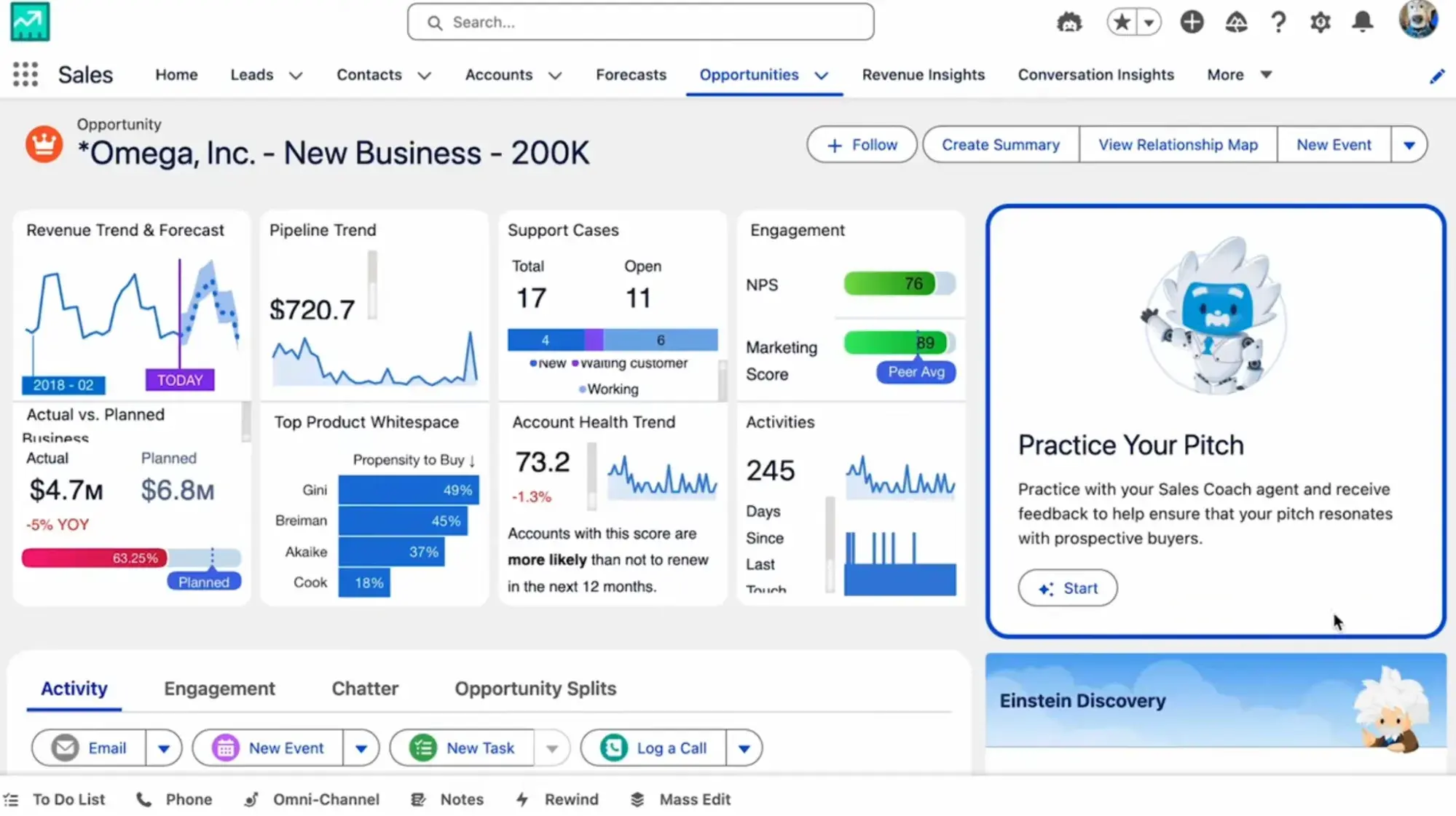
Agentforce Sales (formerly Sales Cloud) remains a solid choice for large enterprise sales organizations. Its strength lies in configurability. Virtually every workflow can be customized to match even the most complex organizational requirements. The platform’s AppExchange ecosystem offers thousands of integrations. Einstein AI provides predictive scoring, opportunity health assessments, and automated activity capture.
Core Features
- Opportunity and pipeline management
- Einstein AI scoring
- Flow automation builder and forecasting hierarchy
- Revenue Intelligence add-on
- Slack integration for deal collaboration
Pricing: Agentforce pricing is consumption-based and varies by use case; more advanced plans are up to $550 per user per month.
Best for: Enterprise organizations with complex, multi-region sales hierarchies and the internal resources to configure and maintain an advanced platform.
3. Outreach
Source
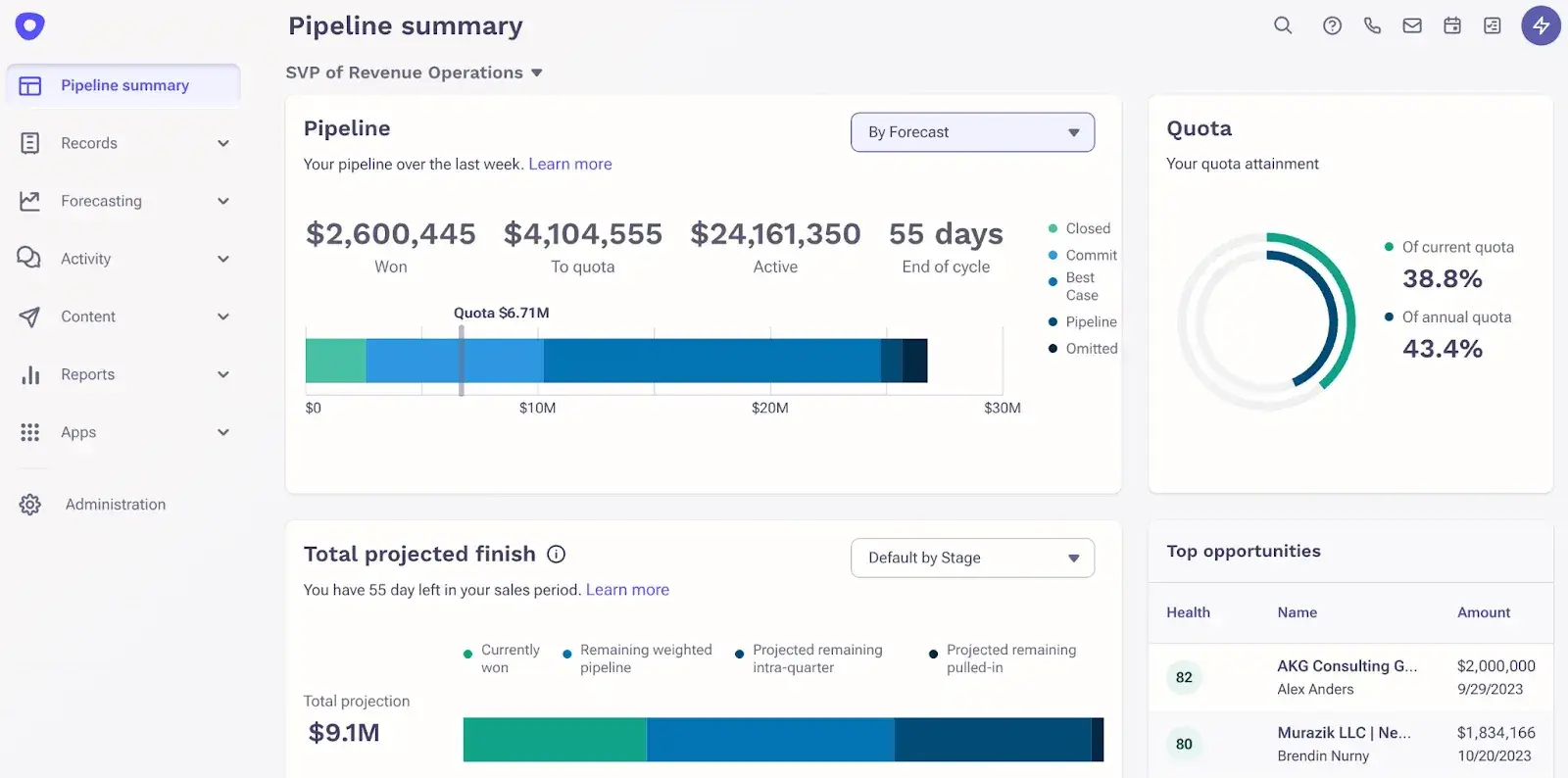
Outreach is one of the leading AI-powered sales execution platforms, purpose-built for revenue teams that run high-volume, outbound motions. Its sequence engine, conversation intelligence (Kaia), and deal health scoring are among the most mature in the market.
Conversation intelligence analyzes sales calls to surface topics, objections, and next steps. Outreach’s 2025 sales data shows that platform users who close deals within 50 days achieve twice the average market win rate. This is a great benchmark for organizations optimizing sales cycle length.
Core Features
- Multi-channel sequencing (email, call, LinkedIn, SMS)
- AI deal scoring and pipeline health
- Conversation intelligence with auto-transcription, revenue forecasting, and deal inspection workflows
Pricing: Custom pricing; typically positioned for mid-market and enterprise.
What I like: Outreach’s AI is deeply embedded in reps’ daily activity. Deal updates are suggested based on conversation history, talk tracks are personalized by buyer context, and voicemails are auto-generated. For teams that take AI in sales seriously (not just as a reporting feature), Outreach is one of the most credible implementations available.
4. Clari
Source
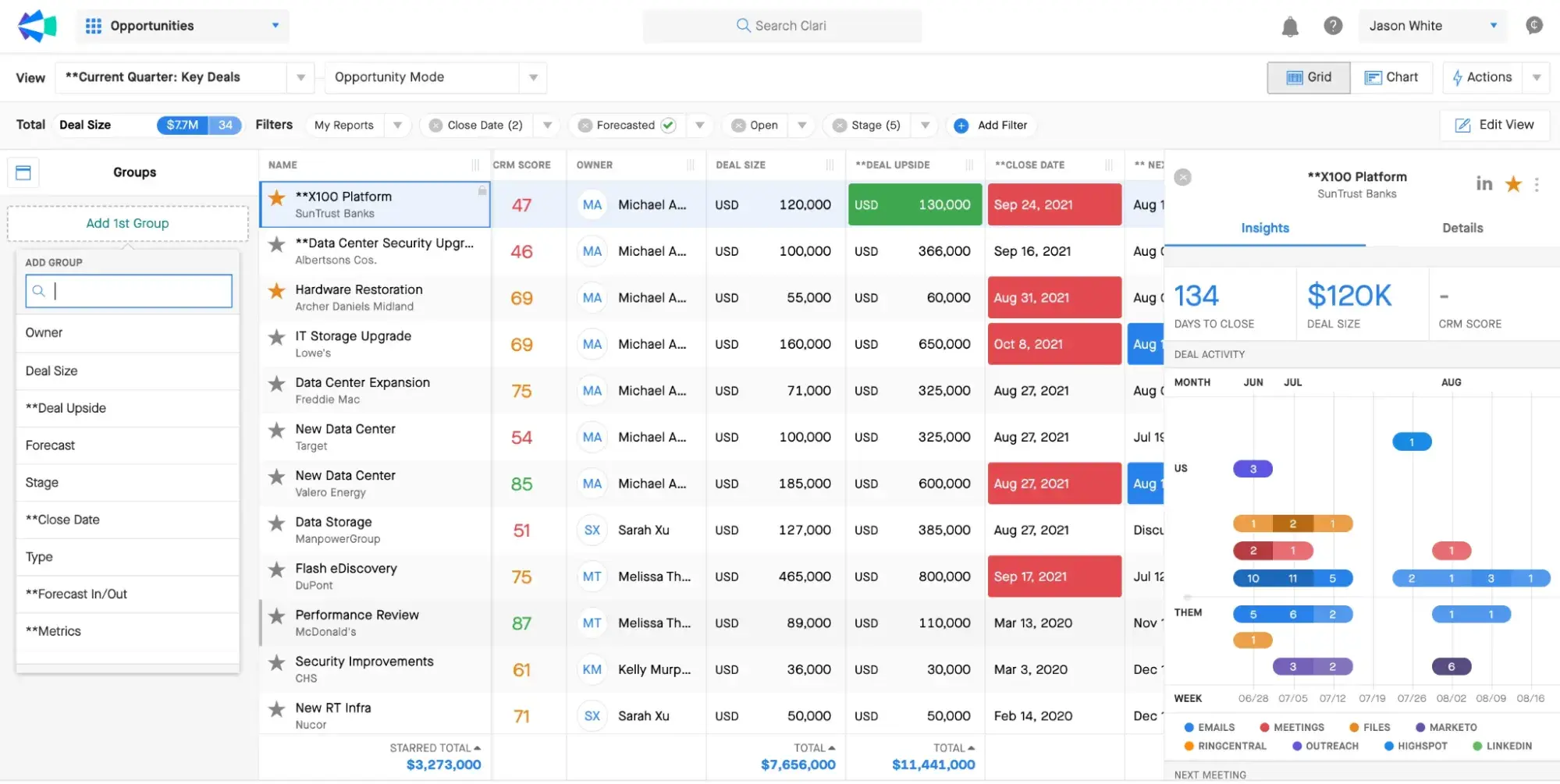
Clari is a revenue operations platform that’s great at AI-driven forecasting, pipeline inspection, and revenue leak identification. Where many platforms treat forecasting as a feature, Clari treats it as the product. Its AI models ingest CRM data and engagement signals to generate accurate call-level forecasts.
Core Features
- AI-driven forecasting (Clari Forecast)
- Pipeline inspection, revenue leak analytics, deal inspection workflows,
- Conversation intelligence via Clari Copilot
Pricing: Custom enterprise pricing. Typically deployed alongside an existing CRM (Salesforce, HubSpot, or Microsoft Dynamics).
Best for: Revenue operations teams at mid-market to enterprise scale that are prioritizing forecast accuracy and revenue leak detection above all else.
5. Gong
Source
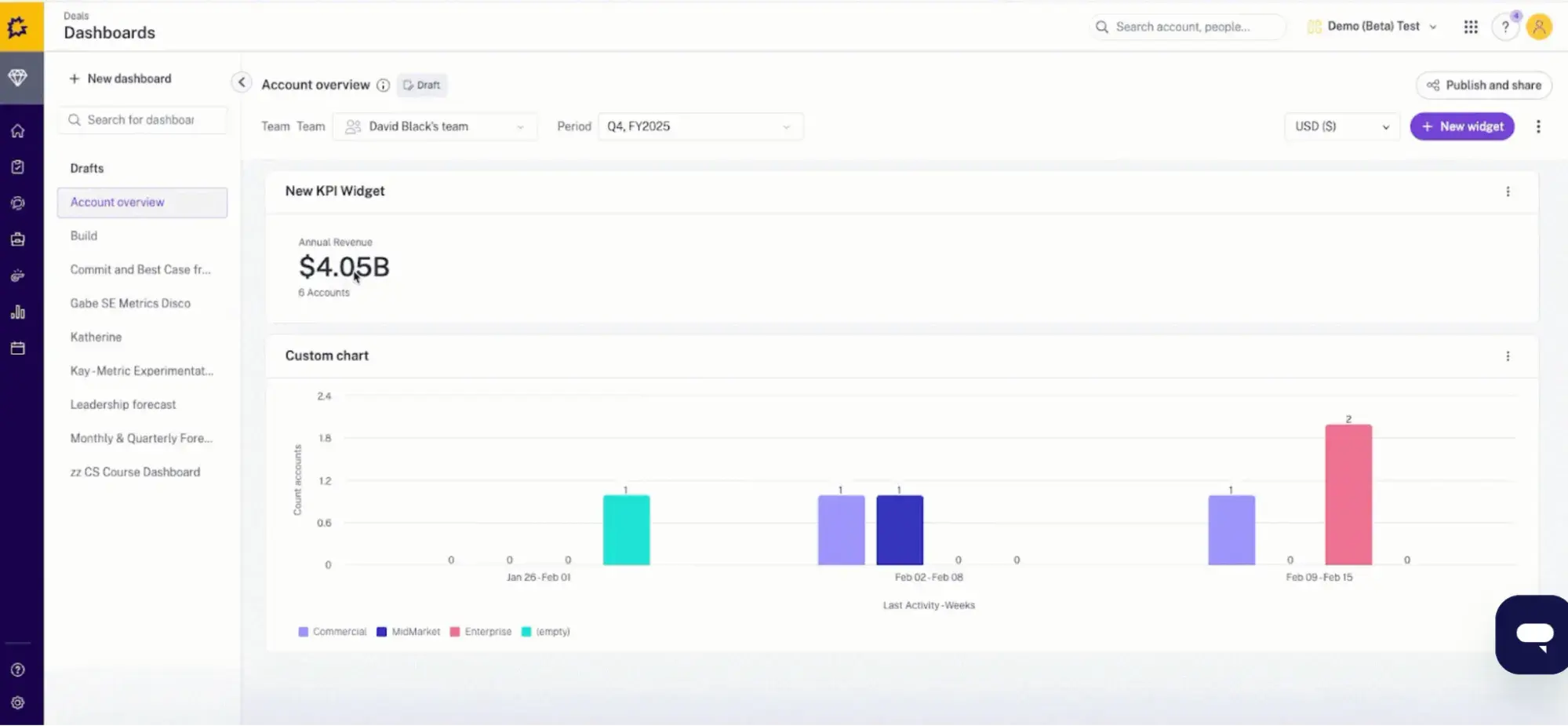
Gong is a market leader in revenue intelligence, with conversation analysis as a core strength. The platform records, transcribes, and analyzes every customer-facing interaction. From there, Gong maps those signals to deal and pipeline data. The platform can surface risk, identify coaching opportunities, and track whether reps are executing on defined messaging.
Gong’s AI models are trained on one of the largest datasets of B2B sales conversations, making its pattern recognition significantly more accurate than other tools.
Core Features
- Call recording and AI transcription
- Deal intelligence and risk scoring
- Rep coaching workflows
- Pipeline analytics
- Gong Forecast
Pricing: Custom enterprise pricing based on seat count and selected modules. Contact Gong for a quote.
Best for: Organizations that want to close the loop between conversation reality and pipeline data, especially teams investing in rep coaching and deal risk identification.
Frequently Asked Questions About Sales Operations Platforms
What is the difference between a sales operations platform and a RevOps platform?
The core difference between sales operations and RevOps platforms is scope. A sales operations platform focuses on the tools and processes that support sales functions. A RevOps platform takes a broader approach, aligning sales with other business units through a unified data layer.
In practice, the distinction is narrowing. Many sales operations platforms have expanded their capabilities to include marketing and customer success workflows. And, many RevOps platforms have deepened their sales-specific tooling. For most growth-stage companies, starting with a strong sales operations platform built on a unified CRM creates a solid foundation. Down the line, RevOps expansion is natural, rather than disruptive.
How do sales operations platforms integrate with my existing tools?
Most enterprise-grade sales operations platforms offer native integrations with common go-to-market tools. Platforms built on a native CRM, like HubSpot, offer strong integration capabilities. Workflows live inside the platform rather than depending on external syncs. Typical integrations include:
- Marketing automation systems.
- Data enrichment providers.
- Business intelligence platforms.
- And communication tools like Slack or Teams.
When evaluating integrations, ask specifically about your highest-priority tools:
- Does the integration write back to both systems?
- How frequently does data sync?
- Who maintains the integration if the third-party API changes?
When should a team move from point tools to a unified platform?
Teams should switch to unified platforms once they notice discrepancies in forecast reliability. That typically surfaces as forecast surprises at quarter-end, growing disagreement between sales leadership and operations, or an inability to explain why deals are won or lost.
Other signals that a unified platform is necessary include:
- Rep onboarding taking longer than expected.
- Operations spending a disproportionate amount of time on manual data cleanup.
- And declining CRM adoption.
How do I assess AI claims from vendors?
The fastest way to stress-test an AI claim is to ask for a live, unscripted demonstration of a specific use case in a production environment. Watch where the AI output appears. Is it in the rep’s daily workflow, or in a separate analytics view that requires a deliberate detour?
Ask what data trains the model, how long it takes to produce accurate predictions for a new customer, and what happens when the underlying CRM data is incomplete or inconsistent. Then, ask for accuracy benchmarks grounded in customer outcomes.
Metrics like “improved forecast accuracy by X% for customers with Y data maturity” are far more useful than generic claims about model performance. If a vendor cannot provide customer-specific accuracy data, treat the AI capability as early-stage regardless of how it’s marketed.
What KPIs should we monitor first after go-live?
In the first 30 to 60 days post-launch, prioritize KPIs that reflect platform adoption and data quality rather than revenue outcomes, as these take longer to manifest. Track CRM field completion rates, sequence enrollment rates as a proxy for rep adoption, and duplicate or missing-record rates as a measure of data hygiene improvement. These operational KPIs indicate whether the platform is being used correctly, a necessary precondition for any downstream revenue impact.
Implementing a Unified Sales Operation Platform
The case for consolidating sales operations onto a unified platform has never been stronger. For teams evaluating where to start or consolidate, HubSpot Sales Hub is worth serious consideration. The platform offers an AI-native foundation that grows with the business. For growing brands, the ability to get value quickly while building toward a more sophisticated RevOps architecture is a strong competitive advantage.


 English (United States)
  Chinese